A summer of breakthroughs
This summer, LLMs helped write remarkable proofs of long-standing open problems.
Two examples among many:
-
A complex structure on
S^6 -
The Navier–Stokes problem

What is formalization?
Formalization means writing mathematical statements and proofs in a precise language so that a computer can check every step of the proof.
-
Every step needs justification, including “obvious” ones. Automation can fill in many of the details.
-
As we need to justify everything, this process can be very tedious.
-
Proof assistants help us write these proofs, with mathematical notation and immediate feedback.
-
Making definitions and assumptions explicit often deepens our understanding of the mathematics.
Lean and mathlib
-
Lean is an open-source proof assistant and functional programming language. We use it to write mathematical statements and proofs that Lean checks.
-
mathlib is a community-maintained library of mathematical definitions and theorems, together with their proofs.
-
It covers many areas of mathematics, from linear algebra and analysis to smooth manifolds and schemes.
-
Libraries like mathlib let results from different areas work together: we can reuse existing theorems instead of proving everything from scratch.
An example: the Heine-Cantor theorem
Theorem. Let X and Y be metric spaces, with X compact.
Every continuous map f : X \to Y is uniformly continuous.
Proof sketch. Fix \varepsilon > 0 and consider
K_\varepsilon =
  \{(x,y) \in X \times X \mid d_Y(f(x),f(y)) \ge \varepsilon\}.
-
Compactness. By continuity,
K_\varepsilonis closed in compactX \times X, hence compact. -
A positive minimum. Choose
(p,q) \in K_\varepsilonminimizingd_X(p,q)and set\delta = d_X(p,q). Then\delta > 0, sincep=qwould give\varepsilon \le d_Y(f(p),f(q)) = 0. -
Uniform continuity. If
d_X(x,y)<\delta, minimality gives(x,y)\notin K_\varepsilon, sod_Y(f(x),f(y))<\varepsilon.\square
mathlib supplies the definitions and compactness results used here, and already contains the Heine–Cantor theorem itself.
Can we really trust a Lean proof?
Can we trust a human-written and human reviewed proof?
Can we trust a human-written and human reviewed proof?


Can we trust a human-written and human reviewed proof?
Retracted in 2023
Can we trust a human-written and human reviewed proof?
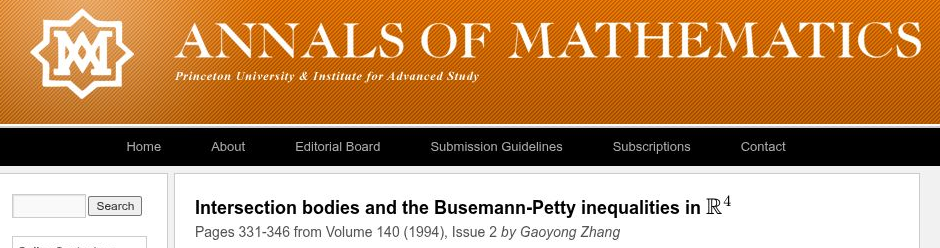

How does Lean check a proof?
-
Correctness is checked by Lean's kernel, a small trusted component.
-
Independent external checkers can verify Lean proofs as well.
-
Lean's standard axiomatic system is equivalent in consistency strength to ZFC plus universes.
-
For each theorem, we can inspect its axiom dependencies and ask an external checker to verify its proof.
-
We still need to check that the formal statement expresses the mathematics we intend.
To what extent can we trust a human-written Lean proof?
-
In July a claimed disproof of the Collatz conjecture compiled. It was not a disproof: it exploited a bug in the kernel, and proved
Falsewith only the standard axioms. -
Over the following weeks four more bugs were found in the kernel. All of them are fixed, in Lean v4.33.1.
-
Every one of them was reached through heavy, deliberate metaprogramming. Nothing of the kind happens when you are simply writing mathematics.
-
So it remains extremely unlikely that a mistake in a human-written proof gets past Lean. That is not what you should worry about.
To what extent can we trust an LLM-written Lean proof?
-
With LLM-written code, the trust problem is harder: we must treat the LLM as an adversary.
-
The code can be enormous and difficult to digest: Claude's formalization of Fermat's Last Theorem contains 13 million lines of Lean.
-
Tools such as Comparator check that the LLM has not “cheated”.
-
Independent proof checkers and up-to-date Lean versions provide further protection against exploits, including previously unknown kernel bugs.
-
Expert review is still needed: all the results announced this summer have undergone such a review.
What LLM-written Lean cannot do
Help us understand the proof
Check the meaning of definitions and statements
Checking statements and definitions
-
Lean cannot guarantee that a definition or statement expresses what we have in mind.
-
Reading Lean code is not always easy.
-
We can trust mathlib, which has undergone extensive and careful human review. For example, we can rely on its definition of
\mathbb{R}: mathlib proves that it is a complete ordered field. -
The definitions involved have themselves been carefully reviewed by humans.
-
A concise statement using mathlib's standard definitions lets us check directly that the theorem says exactly what we intend.
The Formal Conjectures repository
-
Formal Conjectures collects statements of mathematical problems in Lean, using mathlib, including many open conjectures.
-
Contributions undergo careful review of both definitions and statements.
-
When autoformalizing a proof of a conjecture in the repository, we can reuse its formal statement.
-
This approach was used for the complex structure on
S^6and the Navier–Stokes problem. -
Work is underway on a formal statement of the Hodge conjecture.